Cognitive Offloading Compared to What? A Recap
Why is "offloading" an interesting way of thinking about students and AI?
The most common worry I hear from faculty, and it is a reasonable worry, goes like this: when students use generative AI, they outsource the thinking. The machine analyzes, evaluates, and creates, and the student collects the output. Whatever higher-order thinking used to happen in the assignment now happens in the model. We call this cognitive offloading, and the term does a lot of work in policy conversations, usually as a reason to restrict.
For a researcher, this worry raises two questions. First, offloading compared to what? The implicit baseline is a student who, absent AI, would have done the analysis herself. But anyone who has graded a stack of papers knows that baseline is generous. Some students were already offloading to search engines, to friends, to the first paragraph of the first source they found. The counterfactual to AI use may not always be deep thought. Sometimes it can be shallower thought with worse tools.
Second, and less familiar: offloading while doing what? "Using AI" is not one behavior. This is where I ran into a problem in my own classrooms.
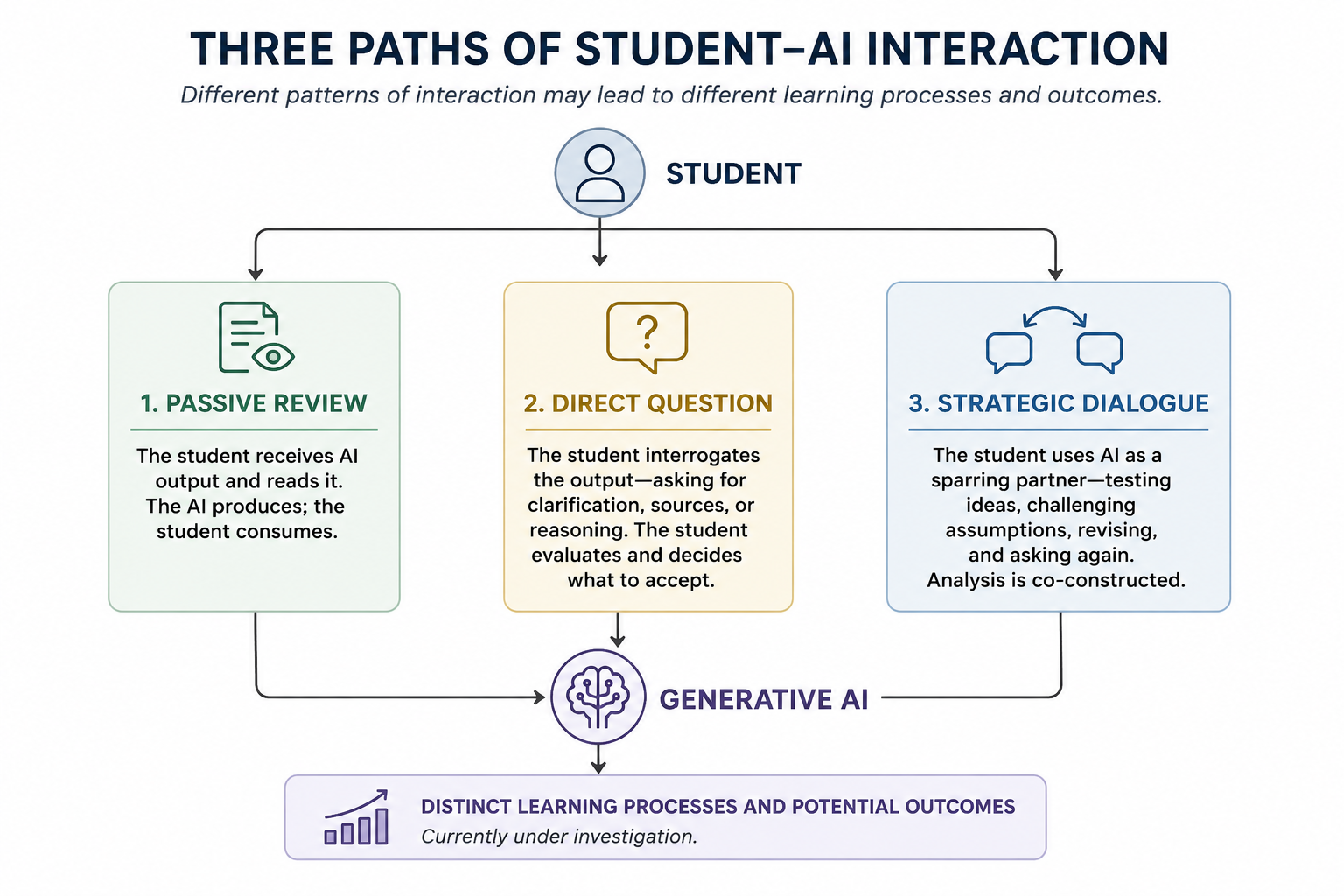
When I began observing how graduate students actually interacted with generative AI, I could not describe what I saw with a single verb. So I stopped trying and started sorting. Three patterns kept recurring.
In the first, which I call Passive Review, the student receives output and reads it. The AI produces, the student consumes. If offloading happens anywhere, it happens here. And the worry is well placed.
In the second, Direct Question, the student interrogates the output. She asks for clarification, for a source, for the reasoning behind a claim. The AI is doing work, but the student is doing evaluative work on top of it, deciding what to accept.
In the third, Strategic Dialogue, the student uses the AI as a sparring partner. She states a position, asks the model to attack it, revises, and asks again. Here the direction of offloading is hard to even specify. The student is not outsourcing analysis. Instead, she is actually manufacturing occasions for it.
The point is that any claim of the form "AI use affects student thinking" collapses the three into one, and the three should not produce the same effects. A policy that treats them identically, whether it bans all three or blesses all three, is regulating a behavior that does not exist as a single behavior.
This is also where I have to be honest about what I do not yet know.
The typology tells me where to look. It does not yet tell me what I will find, because the instruments we use to measure critical thinking were built for classrooms without AI in them. A standardized test of critical thinking asks the student to perform analysis alone, on demand, in a fixed window. But if what changes in a Strategic Dialogue classroom is the student's disposition to seek out challenge, or her calibration about when to trust a fluent answer, a solo timed test may be exactly the wrong place to look for it. We may be in the uncomfortable position of intervening on one construct and measuring an adjacent one.
So the recap goes something like this. The offloading worry is legitimate, but it is underspecified twice over. Because the worry assumes a baseline of unassisted deep thinking that often was not there. It also assumes AI use is one behavior when it is at least three. Sorting the behaviors is the easy part. Building measures precise enough to detect what each one actually does to thinking, and who bears the cost when we get that measurement wrong, is the part I am still working on.